

Reproductive Medicine: facts & figures
Reproductive medicine can help couples who are infertile or at risk of transmitting a serious genetic disease. Who undergoes treatment and how many children are conceived with medical assistance? A monitoring programme provides data on reproductive medicine.
Each year in Switzerland, about 6500 couples who are infertile or carriers of a serious genetic disease seek medical assistance to conceive a child. Around 28 reproductive medicine centres are available. Approximately 2500 live births per year occur as a result of assisted reproduction.
The Reproductive Medicine Act (RMA) specifies the conditions under which assisted reproductive techniques may be used. The purpose of the regulations is to protect human dignity, privacy and the family. Whether the Act fulfils its purpose was determined by a review of its effectiveness. As part of this review, the FOPH, as a first step, introduced a monitoring programme. This programme systematically collects data on reproductive medicine in Switzerland, thus creating transparency.
Overview of published data and sources
The data published here is divided into three main sections:
- Medical practice in the area of reproductive medicine: This section includes charts on the following four areas: in vitro fertilisation (IVF) and insemination; testing of embryos (preimplantation diagnosis); pregnancies and births after IVF; and preservation of reproductive cells.
- Actors in reproductive medicine: This section focuses on physicians who require a licence to use assisted reproductive techniques and laboratories which require authorisation to perform genetic testing on embryos.
- Sperm-donor-conceived children: This section includes charts on sperm donors and on donor-conceived children.
The data presented in the charts comes from the following sources:
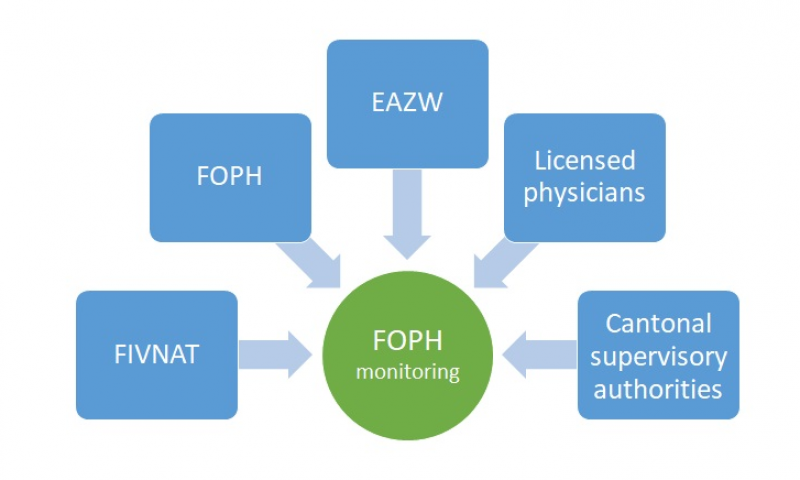
- Fécondation In Vitro National (FIVNAT) is a committee of the Swiss Society for Reproductive Medicine (SGRM) which collects IVF data. See the section on Medical practice in the area of reproductive medicine.
- The FOPH grants authorisations to laboratories which perform genetic testing on reproductive cells or embryos. These laboratories require authorisation under Article 8 of the Federal Act on Human Genetic Testing (HGTA). See the section on Actors in reproductive medicine.
- The Federal Office for Civil Registration (EAZW) manages data in accordance with the RMA on sperm donors and donor-conceived children. See the section on Sperm donor-conceived children.
- The licence holders are physicians who use assisted reproductive techniques, preserve reproductive cells or arrange the supply of sperm cells and therefore require a licence under Article 28 RMA. For the purposes of monitoring, they are directly surveyed. See the section on Medical practice in the area of reproductive medicine.
- Responsibility for enforcement of the RMA lies with the cantonal supervisory authorities, who are directly surveyed for monitoring purposes. See the section on Actors in reproductive medicine.
Further information
Further topics

Reproductive medicine
Some 3,200 couples embark on an assisted reproductive treatment every year in Switzerland. Assisted reproductive techniques are evolving rapidly and raise complex ethical and legal questions.
Reproductive Medicine Act effectiveness review
The Federal Office of Public Health has been commissioned to review the effectiveness of the Reproductive Medicine Act (RMA). The aim of the review is to investigate whether the Act is being implemented effectively and appropriately and whether it is achieving its objectives.
Legislative projects regarding reproductive medicine
The FOPH is responsible for legislative projects in the reproductive medicine field. The FOPH is currently working on a proposal to implement the parliamentary motion to legalise egg donation.
Parliamentary business regarding reproductive medicine
Since the Reproductive Medicine Act came into force in 2001, a large number of parliamentary motions and initiatives have been submitted.
Reproductive medicine: expert opinions and recommendations
On this page you will find a compilation of expert opinions and recommendations, mainly relating to the legal regulations on reproductive medicine.
Federal Office of Public Health FOPH
Biosafety, Human Genetics and Reproductive Medicine Section
Schwarzenburgstrasse 157
Switzerland - 3003 Bern