

Security in the supply of medicines
The supply of medicines in Switzerland is currently in all cases. Despite the action already taken, the supply remains tight. The federal government is now taking additional measures to improve the supply situation.
Shortages in supplies of medicines are increasing worldwide, and Switzerland is no exception. The situation remains tight and is clearly reflected in the reports of the Reporting Office for Essential Human Pharmaceuticals to the Federal Office for National Economic Supply FONES.
This particularly involves generics and medicines with expired patent protection, especially strong painkillers such as opioids, vaccines, insulin and antibiotics. Many patients are therefore affected.
Causes of shortages in the supply of medicines
The causes of such shortages and their consequences are complex. They are largely of global origin, and have evolved over the decades. In addition to the global causes, there are also some Switzerland-specific characteristics which may promote such supply shortages. These causes and consequences can be summarised as follows:
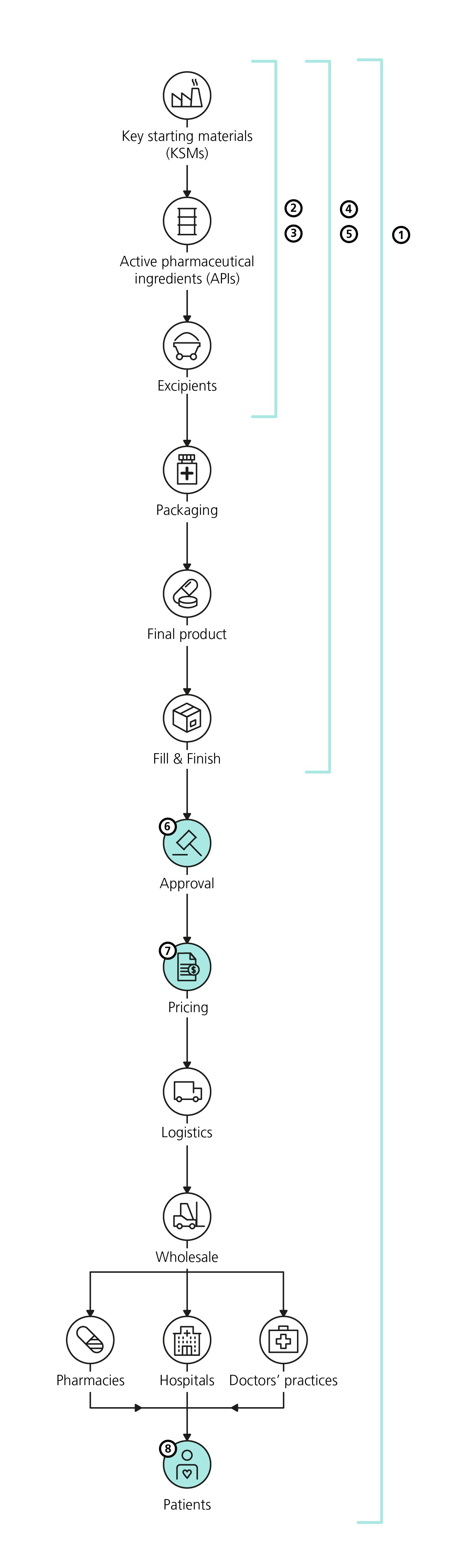
1 Economic pressures, subsidisation policies and looser regulatory provisions in low-wage countries have led to a globalisation of the pharmaceuticals sector.
2 Vital parts of the value chain, including the production of key active pharmaceutical ingredients (APIs), have been relocated to Asia (e.g. China and India).
3 The concentration on a handful of suppliers and the resulting interdependencies have increased substantially. Around a third of the APIs used in the US generic medicines market are now supplied by a single provider, and a further third are supplied by just two or three providers.
4 Modern production and supply chain approaches such as just-in-time manufacture and delivery result in fewer reserves being maintained throughout the value chain. Just-in-time production and supply is a synchronous-with-demand production approach in which the materials needed are delivered in the precise quantities and at the precise time required for the product’s manufacture. But because of limited production reserves, sharp increases in demand cannot be managed.
5 The cluster risks to which global supply chains are exposed are increasing, and this in turn has weakened their resilience to external factors such as geopolitical conflicts, export restrictions, natural disasters, pandemics and sudden peaks in demand.
6 To bring a medicine to market in Switzerland, a manufacturer must have its products approved in accordance with Swiss regulations.
7 For the globally-focused pharmaceutical industry, the Swiss market is relatively small by international standards and thus not particularly attractive in economic terms.
8 For the reasons outlined above, the markets cannot respond adequately. Pharmacies and hospital pharmacies produce medicines for patients. Statutory exceptional regulations are applied, such as the limited placing on the market of medicines not approved for use in Switzerland. Patients receive substitute treatments.
What the Swiss Confederation has done so far
In Switzerland, responsibility for ensuring security of supply lies primarily with the private sector (Art. 102 Federal Constitution and Art. 3 para. 1 NESA), while the cantons are essentially responsible for the healthcare system in their territory (subsidiary general competence of the cantons; Art. 3 and Art. 42 para. 1 Federal Constitution). The federal government today has only a subsidiary responsibility to ensure security of supply in the event of severe shortages (Art. 102 Federal Constitution in conjunction with NESA) or a pandemic, if vital goods and services or the most important remedies to combat communicable diseases are lacking (Art. 118 para. 1 let. b Federal Constitution and Art. 44 EpidA).
A constitutional requirement of this kind does not presently exist. The federal government’s scope for action here is limited, but it still plays a coordinating role and is actively involved in seeking good solutions.
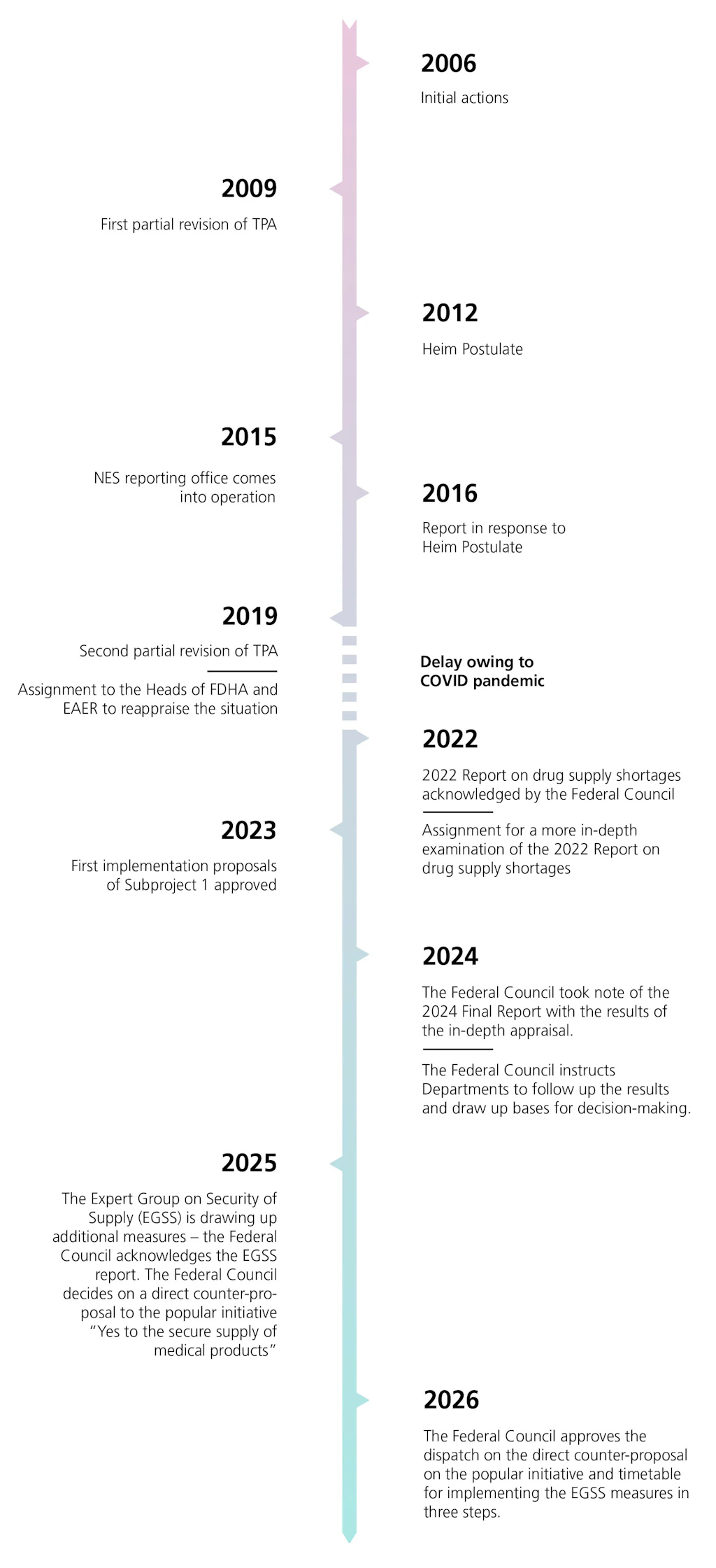
2006 The Federal Council takes steps for the first time to improve the secure supply.
2009 The first phase in the revision of the legislation on therapeutic products lays the legal foundations to enable hospitals to better ensure that their patients can be provided with the medicines they require.
2012 The Federal Council is mandated through a parliamentary postulate (Heim Postulate 12.3426) to analyse the supply situation in Switzerland.
2015 The NES puts its Reporting Office for Essential Human Pharmaceuticals into operation.
2016 The Federal Council’s report in response to the Heim Postulate (2012) "Security in the Supply of Medicines” proposes structural and procedural actions for both the Confederation and the cantons designed to improve the reliable and orderly supply of medicines effectively in the long term.
2019 With the second phase in the revision of the legislation on therapeutic products, the changes proposed under the Heim Postulate enter into force. The Federal Council thus again takes action to expand the scope available to the parties responsible for ensuring the provision of medicines for patients. These include expanded possibilities of own production and the temporary placing on the market of medicines that are not authorised in Switzerland.
To supplement the measures already taken, the FOPH – together with the Therapeutic Products Division of the NES, Swissmedic and the Armed Forces Pharmacy – is commissioned to conduct a renewed analysis of supply chain security in Switzerland and propose additional measures.
2022 The report entitled “Shortages of supplies of medicines for human use in Switzerland: situational analysis and improvements to be considered” is formally acknowledged by the Federal Council on 16 February 2022.
With the publication of the “FOPH report on shortages of supplies of medicines”, the Federal Department of Home Affairs (FDHA) and the Federal Department of Economic Affairs, Education and Research (EAER) are tasked with conducting an in-depth review of the listed measures and drawing up specific implementation proposals. This work is done in collaboration with the Federal Department of Defence, Civil Protection and Sport DDPS (especially the Armed Forces Pharmacy) and with relevant stakeholders from the healthcare sector.
2023 The first proposals for implementation are submitted to the Federal Council. At the request of the NES Therapeutic Products Division, the Federal Council resolves to extend the reporting obligation and look into expanding the reporting platform.
2024 The NES submits various expansion options to the Federal Council. In January, the Federal Council instructs the EAER to develop a high-performance, future-oriented monitoring platform for therapeutic products.
In August, the Federal Council takes note of the 2024 Final Report entitled “Implementation proposals for the measures of the FOPH report on shortages in the supply of medicinal products, final report of the interdisciplinary working group”. This contains the results of the appraisal together with an additional package of implementation proposals for improving the supply situation for medicines in Switzerland. The Federal Council issues orders to the FDHA, EAER and DDPS to implement structural measures designed to make the system more resilient to supply disruptions.
The Federal Council also acknowledges that the FDHA is to deploy an Expert Group on Security of Supply (EGSS) in collaboration with the EAER to determine further measures and report on its findings and the next steps proposed by the end of 2025.
The aim is to ensure that account is taken of the dynamic developments in connection with the supply of medicines.
The popular initiative “Yes to the secure supply of medical products” is submitted to the Federal Chancellery and becomes a reality.
2025 The EGSS issues a technical report summarising its analyses and recommendations. The report praises the Federal Council’s decisions to date on strengthening security of supply and proposes supplementary actions. The report is formally acknowledged by the Federal Council in October 2025. In a next step, the Confederation’s specialists consider to what extent the proposals made by the group of experts can be implemented.
To bridge acute shortages of medicines, Switzerland’s Cantonal Pharmacists (KAV), the FOPH and Swissmedic have jointly agreed to temporarily extend the meaning of the term “emergency” in Article 49 of the Medicinal Products Licensing Ordinance (MPLO). In this way, urgently needed medicines that are not authorised or not available in Switzerland can be imported and temporarily stored even if they are not intended solely for one particular patient. The new regulation will improve the situation in paediatrics in particular, because medicines suitable for children are particularly susceptible to shortages. It is a transitional solution that will apply until the legislative provisions amended as part of the ongoing revision of TPA 3b take effect.
The Federal Council decides to offer a direct counterproposal to the popular initiative “Yes to the secure supply of medical products”.
The aim is to emphasise where action is most urgently needed and where the impact is greatest, i.e. on everyday, commonly used medicines.
2026 In March, the Federal Council approves the dispatch on the direct counterproposal to the popular initiative. It also decides on the next steps in implementing the proposals of the Expert Group on Security of Supply. The measures are to be implemented gradually and in a coordinated manner. In a first step, the import of medicines is to be facilitated by simplifying the package inserts (e-leaflet) and medicine packaging. Moreover, pharmacies should be permitted to coordinate the production of medicines at the national level in order to avoid and deal with any supply disruptions. The authorisation procedures for medicines are also to be further simplified and the Federal Council is reviewing the recognition of EU approvals. In addition, the topic of the secure supply of medicines is incorporated into the Confederation's security policy strategy. In a second stage, the Confederation envisages categorising medicines to record their significance for the supply and working with industry to review the question of how the availability of information on medicine shortages can be improved. Preliminary work on this is started immediately. In the long term, a new federal responsibility is to be drawn up as part of the implementation of the direct counterproposal to the popular initiative in order to make realisation of further measures possible. The direct counterproposal provides for monitoring by the Confederation of the supply situation as regards important medicines. If necessary, the Confederation should also be able to implement additional measures such as creating incentives to support the maintenance of supply-relevant production in Switzerland and to source or organise the production of key goods. Owing to international dependencies, the Confederation should also intervene in the area of foreign policy in favour of supply security. However, these tasks depend on the outcome of the consultation and the decision on the direct counterproposal in parliament and on the popular vote.
In the context of the TPA revision 3b, a number of structural measures in the Federal Council's decisions in 2024 and 2026 will be developed in the areas of market access and the production of medicines and submitted for consultation.
Frequently Asked Questions (FAQ)
Further information and FAQ can be found here:
Frequently Asked Questions (FAQ) on the supply of medicines
Further information
Index
Further topics
Improving supply of medicines
Some commonly prescribed medicines regularly experience supply shortages. Who is responsible if a medicine can’t be delivered? What is the federal government doing for patients, hospitals and care homes?
Frequently asked questions (FAQ) on the supply of medicines
The supply of medicines remains strained. Here you’ll find clear answers to the most important questions about causes, responsibilities and what those affected can do.
Federal Office of Public Health FOPH
Competence center for supply security
Schwarzenburgstrasse 157
Switzerland - 3003 Bern