

New radioactivity monitoring station set up on the Jungfraujoch
The FOPH is responsible for monitoring environmental radioactivity, particularly in the atmosphere. For this purpose, a new monitoring station has been set up on the Jungfraujoch. This – Europe’s highest-altitude – monitoring station continuously measures radioactivity so that, in the event of a radiological or nuclear incident abroad, any radioactive cloud can be detected at an early stage.
The FOPH continuously monitors environmental radioactivity – in the atmosphere, water, soil, food and animal feed. This task, part of our legal mandate, is carried out in collaboration with other cantonal and federal laboratories.
The FOPH focuses on monitoring airborne radioactivity, using the automated network UraNet Aero, which comprises 15 stations. These are distributed throughout the country, especially near nuclear power plants. In addition, high-volume samplers (HVS) operate at six sites, enabling highly sensitive aerosol measurements.
Permanent monitoring station replaces periodic flights
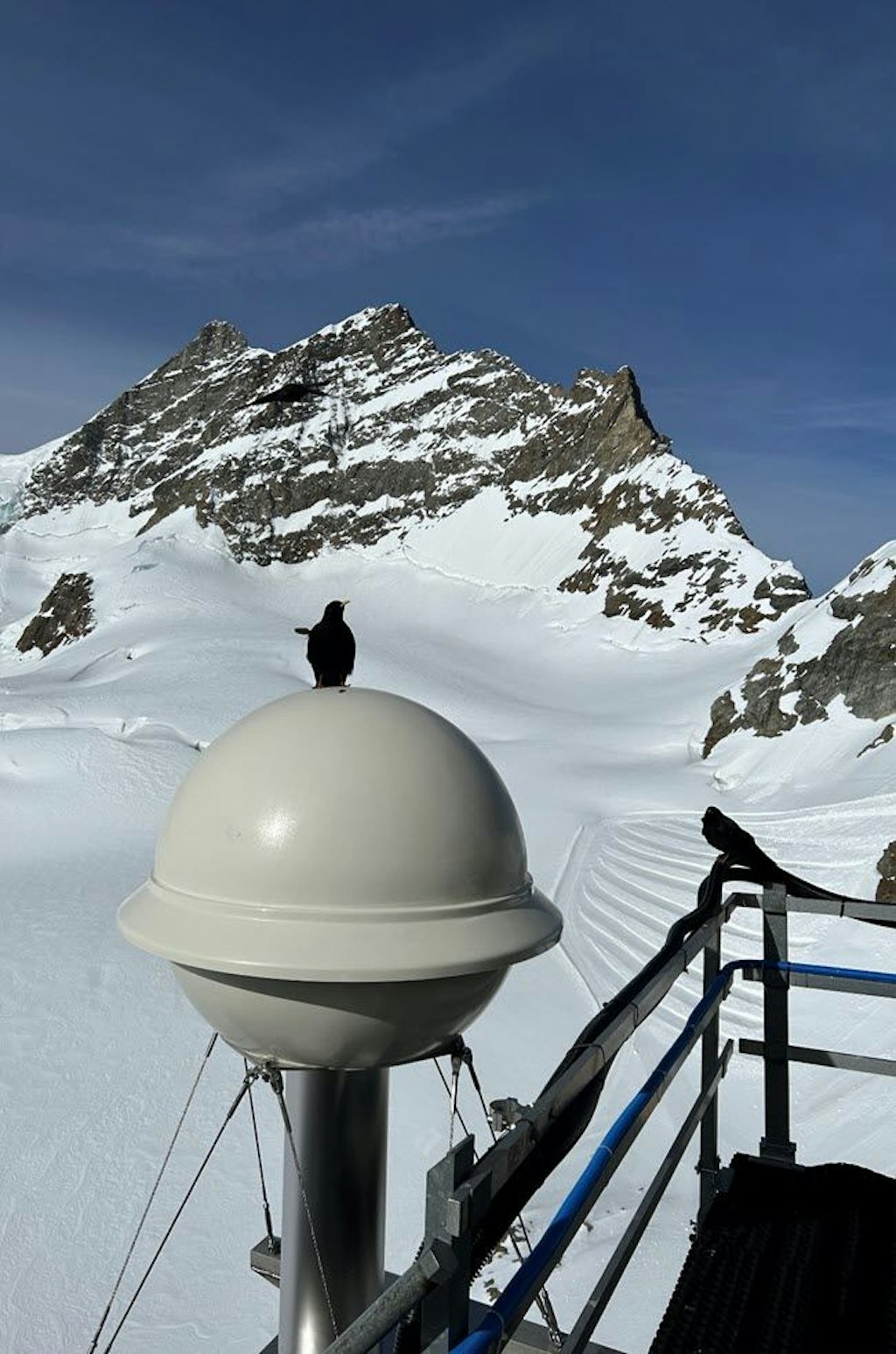
The new monitoring station, at an altitude of almost 3,500 metres above sea level, lies in the free troposphere, thus offering conditions for sensitive measurement of radioactivity that are unique within Europe. As long-range transport of air masses occurs most rapidly in the free troposphere, the location of the new monitoring station means that it can quickly detect very low concentrations of airborne radioactivity, even if it originates from outside Switzerland.
A radioactive cloud reaching Switzerland after a nuclear incident abroad can be rapidly detected and characterised by the new monitoring station, irrespective of its cause (accident at a nuclear power plant, use of a nuclear weapon, or military attack on a nuclear facility). Early detection of a radioactive cloud – before radioactivity is deposited on the ground – is crucial, so that precautionary measures can be taken to protect public health.
Strengthening security
Knowledge of the type and concentrations of radionuclides in a radioactive cloud also provides valuable indications as to the possible causes of the incident, if these are not disclosed by the authorities in the country of origin. With the new monitoring station, the FOPH is not only helping to protect public health, but also strengthening Switzerland’s security.
As Europe’s highest-altitude monitoring station, the new facility will make an important contribution to radioactivity monitoring at the European level. It is part of the informal Ring of Five (Ro5) network (available in French), comprising around fifty highly sensitive monitoring stations throughout Europe. The results from this site will be shared with our European partners.
Technical challenges
Measuring airborne radioactivity at an altitude of 3,500 metres is technically highly challenging. The system must be capable of filtering large volumes of air, even under extreme conditions, such as temperatures as low as -30°C, high levels of humidity and strong winds. To meet these requirements, the FOPH has developed new technical solutions.
The Jungfraujoch monitoring station also differs from the other UraNet Aero stations in that it filters significantly higher air volumes. The design of the intake pipe and the control system for the pump, heating elements and sensors had to specially developed for this site. In fact, 100,000 m3 of air per week is collected and filtered at the Jungfraujoch station.
The implementation of this automated monitoring station with highly sensitive, nuclide-specific measurement in the free troposphere is unique. It was only possible thanks to the scientific expertise and technical skills of FOPH staff, who are recognised specialists in the field of airborne radioactivity monitoring.
Further details can be found in the fact sheet below.
Further information
Further topics
Radioactivity in the air: trace analyses (HVS)
We operate six high-volume aerosol collectors to measure aerosol-bound radioactivity in outdoor air. The air filters are changed weekly and measured in the laboratory using gamma spectrometry.
FWP aerosol collector
In addition to the high-volume samplers (HVS), the URA section also operates three aerosol samplers with a lower volume throughput (approx. 40 m3/h). These devices continuously filter dust from the ambient air.
Federal Office of Public Health FOPH
Ambient Radioactivity Section
Schwarzenburgstrasse 157
Switzerland - 3003 Bern