
Perspectives on drug policy up to 2030

Recent years have seen a reorientation of the drug policies in various countries. Therefore, the Federal Council has reviewed the current drug policy situation and identified possibilities for the further development of the policy in this area.

Since the 1990s, patterns of drug use have changed with the emergence of so-called recreational drugs. The fourfold approach on which drug policy was based, needs to be adapted to address current challenges.

Action is required primarily with regard to cannabis. In addition, in view of potential therapeutic applications, the question arises whether medical access to such substances is adequately assured.

In a report adopted in April 2021 (in response to Postulate 17.4076 submitted by Paul Rechsteiner), the Federal Council reviewed the current situation with regard to drug policy and defined measures for the coming years.
International developments

The aims of the UN International Drug Control Conventions – combating drug abuse through international prohibitions and strict control measures, while at the same time enabling medical use – have not been achieved to date. In recent years, drug policy has therefore been reoriented in various countries: a number of countries have decriminalised drug use, facilitated access to medical use of cannabis, or legalised recreational use of cannabis.

Effects of new approaches

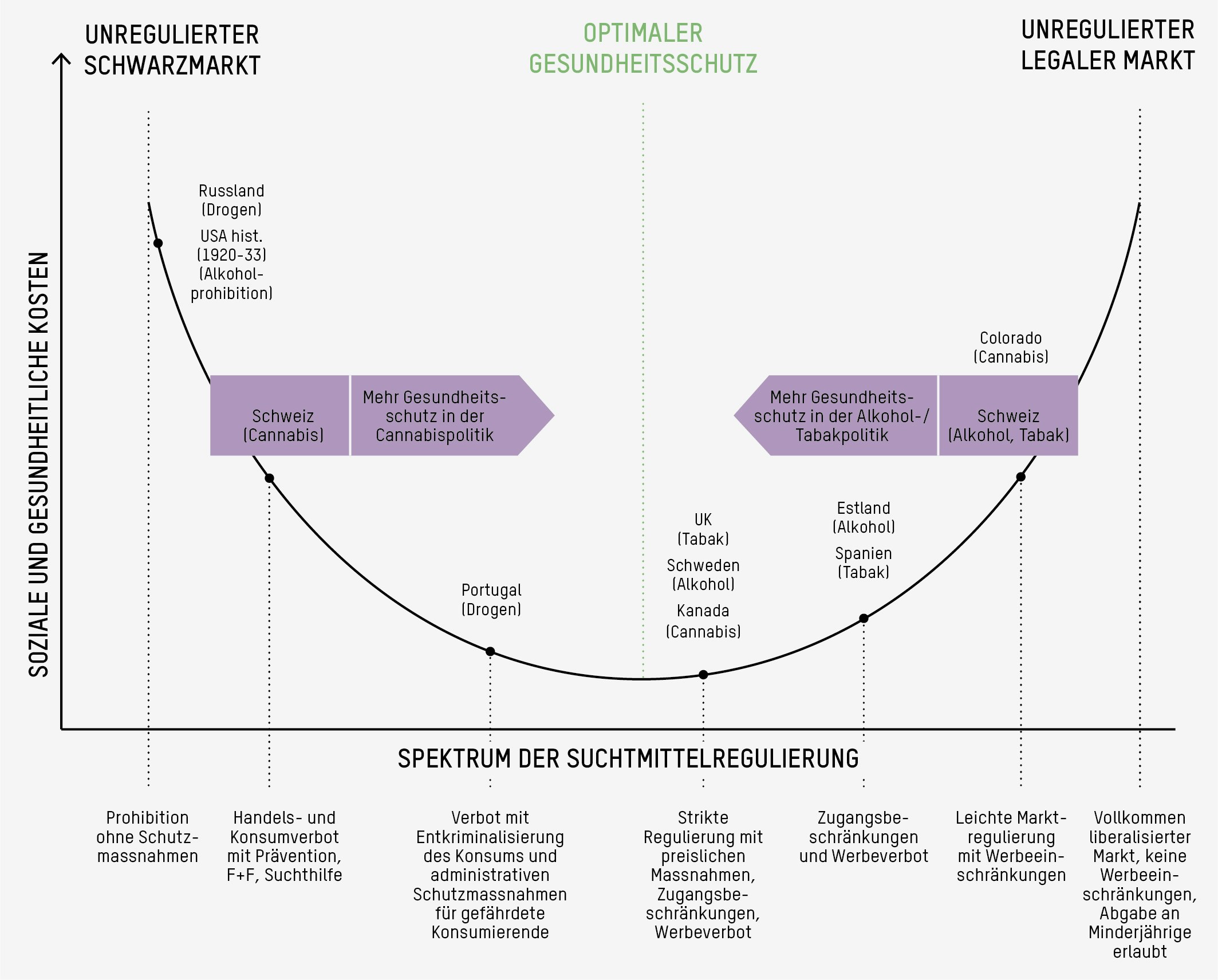
National and international experience with the regulation of legal and illegal drugs indicates that the social costs and health costs of substance use are highest with either strict prohibition or with a fully liberalised, legal market for such substances (cf. Fig. 1). Between these two approaches, various regulatory models are available – such as decriminalisation of substance use or strict market regulation – which are likely to lead to better protection of health and lower costs for society.

Gaps and need for changes in addiction services

Overall, the addiction counselling and treatment services available in Switzerland are of high quality. However, additional efforts are required to ensure that equal access to appropriate care and treatment is available in all cantons:

  • Regional differences exist with regard to low-threshold harm reduction services, particularly in the custodial sector.
  • These differences are partly attributable to differences in cantonal financing structures.
  • New treatment requirements are increasingly arising from the ageing of persons receiving heroin-assisted treatment.

Changes in drug use patterns

Since the closing down of the open drug scenes, patterns of drug use have changed significantly. Most prominent today is the widespread use of cannabis, but the importance of other so-called recreational drugs has also increased. Generally this does not involve severe forms of dependence, but excessive, inappropriate drug use, or mixed use of psychoactive substances and alcohol.

New approaches are needed to improve access to prevention and harm reduction services for users, and to detect heavy use at an early stage.

Deficiencies in prevention and youth protection

For the protection of minors more restrictive provisions were introduced with the partial revision of the Federal Act on Narcotics and Psychotropic Substances (NarcA) in 2008. However, the use of psychoactive substances among young people cannot be prevented solely by prohibitions on supply and use.

  • In addition to the legal protection of minors, there is a need to strengthen the early intervention for young people at risk.
  • Early health promotion must be improved for all children, already in preschool children.

Need for legislative action

The legal basis for Swiss drug policy is the Narcotics Act of 1 June 1952. Certain aspects of this legislation are in conflict with social realities and give rise to enforcement challenges:

  • National Strategy on Addiction for 2017–2024
  • The prosecution of users and the differing prosecution of narcotic and alcohol use in relation to road traffic means that sections of the population with low-risk use are also criminalised.
  • The analysis of illegal substances as part of so-called drug-checking services is not clearly regulated from a legal viewpoint.
  • With increasing research on potential therapeutic uses of illegal narcotic substances, the question arises whether their prohibition for medical purposes remains appropriate or if it unnecessarily complicates medical use.
  • The legal basis for health promotion and prevention is defined in a variety of special legislation (NarcA, Tobacco Tax Act, Alcohol Act, Gambling Act, etc.), which complicates the implementation and financing of a consistent, non-substance-specific prevention strategy.

The Federal Council’s conclusions

The Federal Council proposes a step-by-step review of drug policy:

  • The fourfold approach is essentially to be maintained.
  • Altered patterns of drug use call for new measures.
  • The existing scientific basis is not yet adequate for an evidence-based fundamental reorientation of the Federal Act on Narcotics and Psychotropic Substances (NarcA).
  • The greatest need for action exists in the area of cannabis. Here, medical and non-medical use is to be regulated separately.
  • In the context of non-dependence-specific prevention, there should be a greater focus on young people.

Measures planned

To address these challenges, the Federal Council proposes 21 measures in the following six action areas.

  • Further development of cannabis policy
  • Strengthening of prevention for children and adolescents
  • Closure of gaps in addiction counselling and treatment services
  • New measures in the area of recreational drug use
  • Review of sanctions for the use of narcotics
  • Safeguarding of drug policy interests at the international level

Further information

Further topics

Federal Office of Public Health FOPH

Prevention of Non-Communicable Diseases Division
Schwarzenburgstrasse 157
Switzerland - 3003 Berne