

International Drug Policy
With its extensive experience in the field, Switzerland is among a number of countries that pursue a proactive approach to public health and put the human dimension centre-stage in their national and international drug policies.
The global drug problem
One person in 17 among the world’s population uses illegal drugs – a total of 296 million people (UNODC 2023), 39.5 million of whom have drug-related health problems. The prevalence of HIV, hepatitis and tuberculosis is significantly higher in this population group.
Cannabis and amphetamines are the drugs most widely used worldwide. Opioid use is less common, but remains the leading cause of overdose deaths.
The international institutional architecture
In view of their transnational and criminal nature, the trade in and use of illegal drugs require a concerted international response. Various institutions are engaged in an ongoing dialogue on the issue. These include:
- the United Nations Office on Drugs and Crime (UNODC), which tackles the global drugs problem at the international level, particularly within the wider context of other safety, security and public health issues;
- the Commission on Narcotic Drugs (CND), which is the central policymaking body within the United Nations’ international system for controlling drugs;
- the World Health Organization (WHO), which focuses on the global health aspects of the drug problem; and
- the Pompidou Group, which is integrated into the Council of Europe and which helps develop drug policies in the Council’s member states.
A problem with various responses
The member states of the above institutions are still struggling to reach a consensus on how to best respond to the global drugs problem. Individual state policies on this currently range from those that focus on abstinence, prohibition and repression to those that view the drug problem primarily as a public health issue and seek to also pay due regard to the human rights of the drug users involved.
Like Switzerland, which is a pioneer in the field, more and more states are coming to concede the failure of the traditional essentially repression-based approaches and are turning away from these. Such models end up encouraging illegal drug activities and also create health and social exclusion problems whose ramifications may even exceed the harm caused by the drugs themselves. But some states continue to pursue the repressive approach, imposing severe punishments (which may even extend to the death penalty) for drug-related crimes.
Drugs policy: the Swiss approach
Switzerland has long been a pioneer in pursuing public health policies that pay due and full regard to human rights considerations, and has been promoting such policies internationally since the early 1990s. Encouraged by political action based on four key pillars – prevention, therapy, risk reduction and repression – that has clearly proved effective (particularly in closing down open drug scenes and in reducing levels of HIV infection among users), the country is a champion of its own approach within the international institutions.
In concrete terms, Switzerland works together with other states and NGOs:
- by making targeted interventions and promoting its approach within the international institutions, at the UN and in the Council of Europe (particularly within the Pompidou Group), and by encouraging collaborations between these and other organisations involved such as UNAIDS, and
- by inviting foreign delegations to Switzerland to find out how the Swiss national four-pillar policy is implemented on the ground.
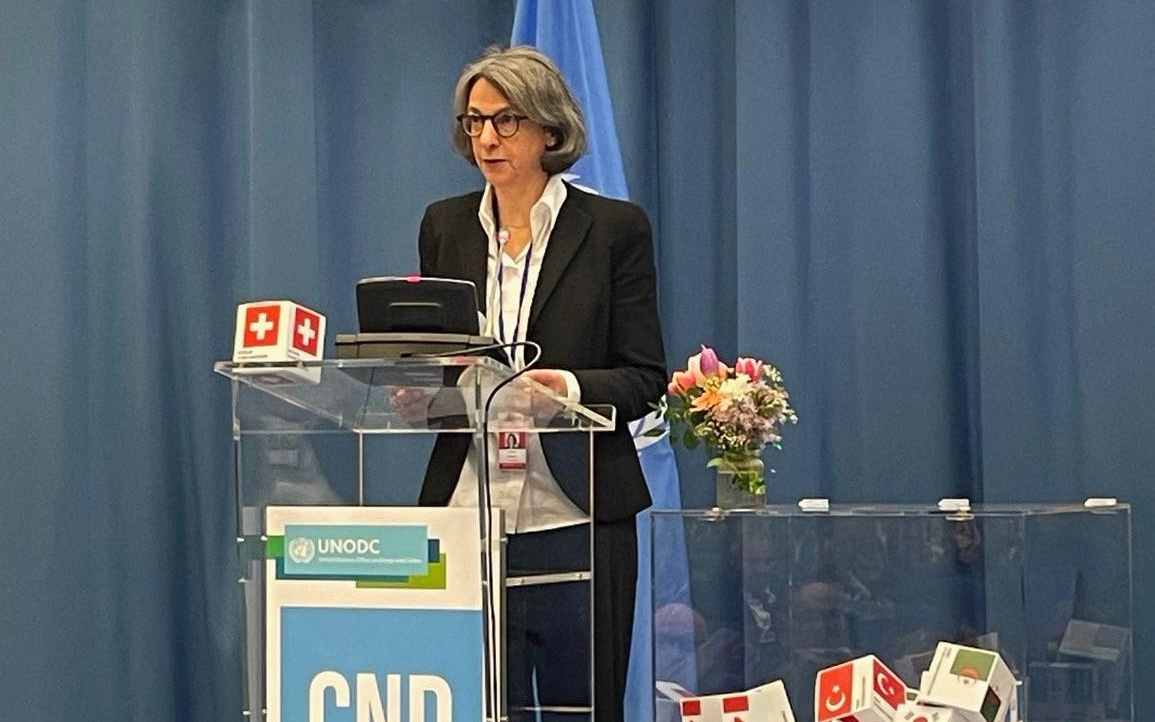
At the 2024 annual session of the UN’s Commission on Narcotic Drugs (CND), Switzerland formally reconfirmed its commitment to a coherent drug addiction policy that is based on both health aims and human rights considerations, that further incorporates aspects of development policy and that duly consults and considers all the stakeholders involved, especially those from civil society.
The session concluded by adopting a resolution on overdose prevention and response. The resolution was something of a landmark event: it explicitly recognised, for the first time in the Commission’s history, the key importance of reducing drug-related risks, an issue on which Switzerland has played a pioneering role for more than 30 years.
Further information
Further topics
Drug policy in Switzerland
Swiss drug policy aims to minimize drug use and its negative consequences. It is based on the four pillars of prevention, therapy, harm reduction and repression.
The Swiss four-pillar policy on Addiction
Swiss drug policy aims to reduce drug use and its negative consequences for users and society. It is based on the four pillars of prevention, therapy, harm reduction and repression.

Addiction & health
Addictions and dependencies pose a risk to individuals and society at large. For this reason we promote people’s health literacy and encourage them to take responsibility for themselves. Here you’ll find information about the various addictions and about addiction prevention, regulation, damage limitation, counselling and therapies.
Federal Office of Public Health FOPH
Schwarzenburgstrasse 157
Switzerland - 3003 Bern