

How radon enters buildings
Radon enters buildings from the soil, possibly leading to indoor air pollution.
Chimney effect
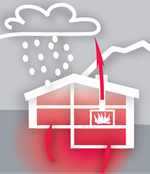
The infiltration of radon from the soil into buildings is mainly due to the so-called chimney effect: warm air rises indoors, leading to a barely perceptible drop in atmospheric pressure in the basement and lower storeys; this produces a suction effect, which may be increased by ventilators or chimneys. During the cold season, the suction effect in the basement is intensified when the heating is switched on.
Leaks in building envelope
Whether radon can infiltrate depends largely on how airtight the building’s foundations are.
Examples of non-airtight elements of the building envelope:
- Cracks and joints in walls and floors
- Opening for windows and pipes
- Dirt or gravel floors
Further information
Further topics
Radon map of Switzerland
Consult the radon map and carry out the radon-check in order to determine the urgency for a radon measurement in your building.
Federal Office of Public Health FOPH
Radiological Protection Division
Radiological Risk Section
Schwarzenburgstrasse 157
Switzerland - 3003 Bern
Radiological Risk Section
Schwarzenburgstrasse 157
Switzerland - 3003 Bern