

Constructional measures against radon
There are straightforward, low-cost means available to protect a building from excessive radon exposure. Preventive protective measures in the course of planning of a new building or renovation work are preferable to subsequent remediation.
Each measure relates to one of the three basic principles of radon protection:
- Radon is prevented from entering the building
- Radon is actively removed before it enters
- Radon is conveyed out of the building
The most commonly used methods for reducing radon exposure are described below:
Preventive protective measures for new buildings and renovations
Basic measures
Systematic implementation of the radon protection measures described in SIA Standard 180/2014 on heat and damp insulation in buildings. Particular care should be taken to reduce underpressure in the building.
SIA Standard 180/2014 on heat and damp insulation in buildings
Additional radon protection measures
Additional protective measures are recommended in the following risk situations:
- The building has a cellar with a natural floor or occupied rooms in contact with the ground
- The probability of exceeding the reference level of 300 Bq/m3 is greater than 10% according to the radon map :
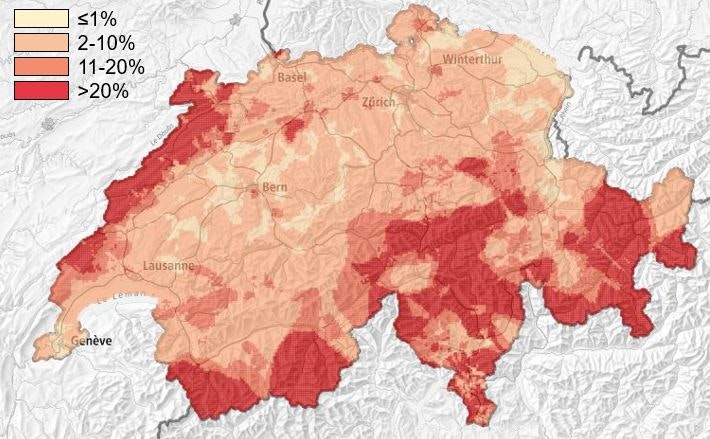
Additional radon protection measures:
- Additional sealing outside or inside the building (e.g. radon barrier membrane or airtight cellar door)
- Controlling air flows (e.g. with radon drainage below the foundation or controlled air changes in occupied rooms)
Specific recommendations for new buildings
No two buildings are identical. Consequently, when planning a new building it is impossible to predict the radon gas concentration. However, preventive measures in new buildings are much less costly than subsequent remedial action.
Concreting the basement: foundation slab
In order to prevent radon from entering the building, the building envelope that is in contact with the soil must be sealed. This requires a continuous foundation slab and walls that are in contact with the soil should be constructed with concrete of the exposure class XC2. Moreover, air-tight inlet and outlet ducts for cables, water, waste water etc. are very important e.g. with a pipe duct system (PDS).
Soil aeration below the building
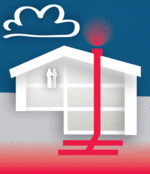
Air circulation under the house
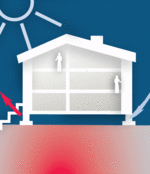
Specific recommendations for renovations
The best way to get a precise indication of the necessity of measures to protect against radon before renovation work is to measure radon beforehand. This applies particularly when it comes to converting basement floors into living space. The concentration of radon also tends to increase when windows are changed.
Radon remediation in existing buildings
If appropriate measurements have shown that the average radon concentration over one year is greater than 300 Bq/m3 in an existing building then radon protection measures should be initiated. The most suitable remedial method depends strongly on each individual case and should be clarified by a qualified radon consultant. Important: Subsequent to each remedial radon treatment, there is an obligatory control measurement!
Sealing the building sections that come into contact with the soil
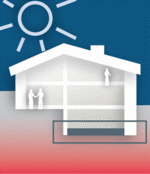
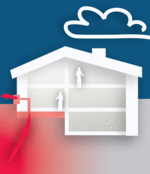
Mechanical ventilation
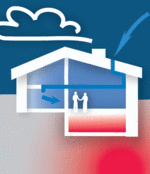
Reduced pressure system under the foundations (radon wells)
Further information
Radon Solutions (Sammlung von technischen Angaben für den Professionellen Umgang mit Radon)
Index
Further topics
Radon map of Switzerland
Consult the radon map and carry out the radon-check in order to determine the urgency for a radon measurement in your building.
Federal Office of Public Health FOPH
Radiological Risk Section
Schwarzenburgstrasse 157
Switzerland - 3003 Bern