

Communicable Diseases Legislation – Epidemics Act, (EpidA)
The Federal Act of 28.9.2012 on the control of communicable human diseases (Epidemics Act; EpidA) has been in force since 1.1.2016, and enables a timely detection, monitoring, prevention and control.
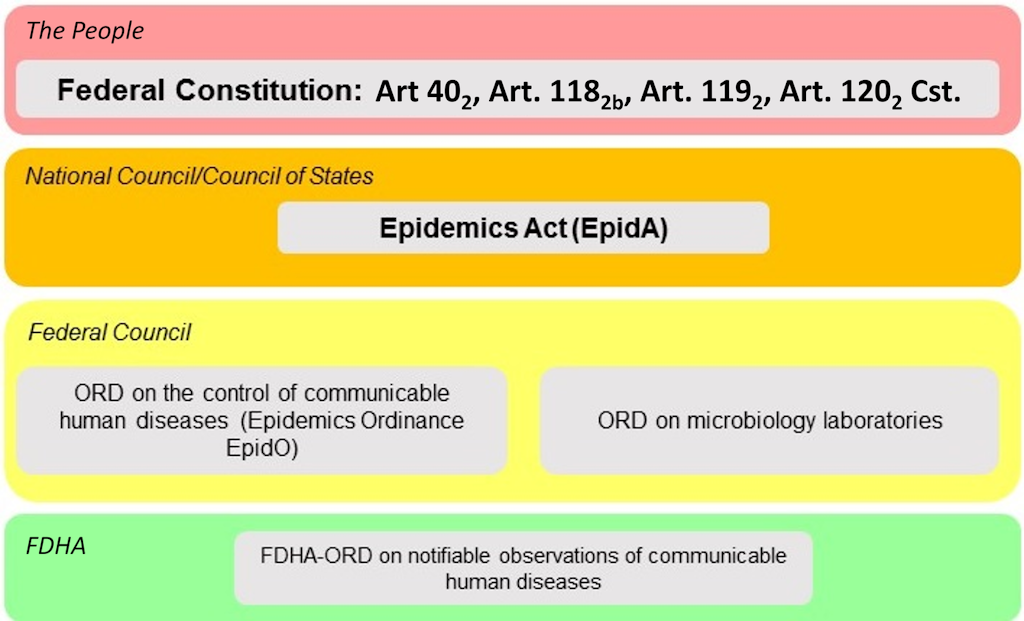
The most important aspects of the legislation
The following central points are highlighted in the Epidemics Act:
- The work-sharing between the Confederation and the cantons in crisis situations is clarified by introducing a three-stage status model. This model provides for special and extraordinary situations in addition to the normal situation.
- In regard to preparations for crises and their management, explicit provisions have been set out to confront new threats and to manage a health crisis. Moreover, the coordination of measures has been defined at the national and international levels. The management of events during crises requires a high degree of coordination and organisation at the federal and cantonal levels.
- The Confederation defines the national objectives and strategies for combating communicable diseases. They are formulated and implemented in collaboration with the cantons. This includes in particular strategies on vaccinations, healthcare-associated infections, resistance to pathogens as well as on HIV and other sexually transmitted diseases.
- A coordination body will facilitate cooperation between the Confederation and cantons in the field of communicable diseases. The objective of a uniform implementation is ensured by a technical interchange of information between the Confederation and cantons and by coordinating the identified measures. In addition, the Federal Council has access to an operational body that can provide assistance and advice for the management of particular or extraordinary situations.
- Measures to protect the population and measures pertaining to the international transport of goods and people are defined and extended when needed.
- New provisions exist for the prevention of communicable diseases. Consequently, national programmes on healthcare-associated infections and antibiotic resistance can be conceived and implemented. In regard to vaccinations the act proposes a national programme as well as a national plan for vaccination. Some new preventative measures relating to lifestyle, working conditions and the environment are scheduled.
- Laboratories that carry out microbiological investigations to identify communicable diseases now require authorisation from Swissmedic. This obligation to obtain authorisation replaces the previous inconsistent and complicated accreditation and authorisation system.
- The previous indemnification system in cases of vaccination damage has been developed further. State benefits in the form of compensation for non-material damage are now explicitly incorporated in the Act. In addition, applications of this sort are centralised and harmonised at the federal level.
- The Confederation is responsible for the supervision of the implementation of the EpidA and coordinates the cantonal measures as needed. It also ensures international coordination. The Federal Office of Public Health (FOPH) is the competent authority in Switzerland for International Health Regulations (IHR) and thus the contact point for WHO on certain public health events, in particular those which may constitute a public health emergency of international concern.
Links to the Act and to the Ordinances may be found here:
Further information
Federal Office of Public Health FOPH
Communicable Diseases Division
Strategies and Legal Bases Section
Schwarzenburgstrasse 157
Switzerland - 3003 Bern
Strategies and Legal Bases Section
Schwarzenburgstrasse 157
Switzerland - 3003 Bern