

Advanced materials
The term “advanced materials” covers a wide range of different materials. Compared to conventional materials, all of them show outstanding, novel properties and are therefore used in diverse fields of application.
What are advanced materials?
Advanced materials are more complex than conventional materials. They often consist of several individual materials and exist in a variety of sizes. Continuous innovation drives the rapid evolution of this class of materials. Due to their small size nanomaterials exhibit outstanding properties, too, and are thus considered a subgroup of advanced materials (compare figure below).
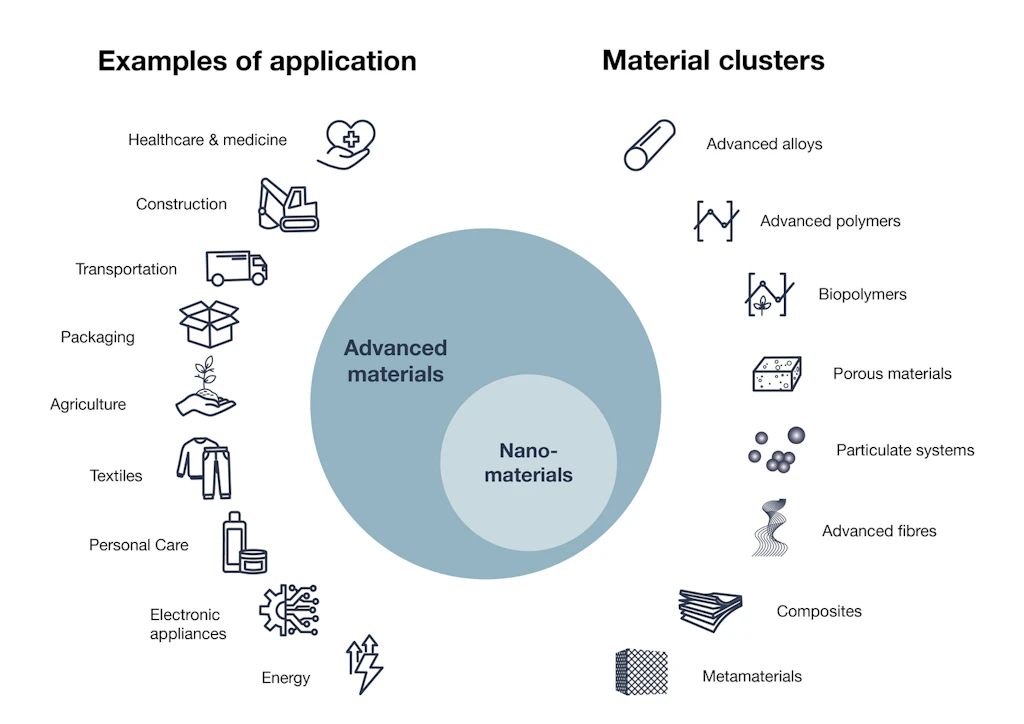
Defining such a diverse group of materials in strict terms is not straightforward. Nevertheless, various international organisations developed explanations of the term “advanced materials”. For example, in 2013 the European Commission described advanced materials as follows: “An advanced material is any material that, through the precise control of its composition and internal structure, features a series of exceptional properties (mechanical, electric, optic, magnetic, etc) or functionalities (self-repairing, shape change, decontamination, transformation of energy, etc) that differentiate it from the rest of the universe of materials.”
The OECD Working Party on Manufactured Nanomaterials (WPMN) also published a description of advanced materials in 2023: “Materials that are rationally designed to have new or enhanced properties, and/or targeted or enhanced structural features with the objective to achieve specific or improved functional performance.” Among others this description is based on a 2020 report of the German Environment Agency (UBA) which discusses a potential classification of advanced materials into different categories. The resulting factsheets provide a brief overview of the characteristic properties of the identified advanced materials, their areas of application and their potential risks as well as their regulatory status. The International Organisation for Standardisation (ISO) is also working on a description of the term advanced materials.
In Europe expectations for the use of innovative materials are quite high. For example, global challenges such as climate change shall be addressed through technical solutions based on advanced materials (for instance, in the context of the energy transition, as described below). Furthermore, they play a key role in digital transformation and in supporting the circular economy. However, there is also an awareness that the full potential of this technology can only be leveraged if potential health and environmental risks are identified and mitigated.
Examples of application
Advanced materials offer new possibilities in various fields, such as medicine, the energy sector or 3D printing. Here, we will briefly describe just a few examples. In medicine (Nanomedicines), nanomaterials have been in use for quite some time due to their specific properties. Given their deliberately engineered properties, nanomaterials can also be considered advanced materials in this context. Most of the currently approved “nano medicines” are based on already existing and approved active substances, the formulation of which has been improved by advanced materials. For example, a cancer drug encapsulated in tiny (i.e. nano-sized) surface-treated lipid “droplets” was approved in Europe as early as 1996. This kind of “wrapping” allows the active ingredient to remain in the bloodstream for longer, reduces side effects and ensures that more of the active ingredient reaches the cancer cells. Certain vaccines (e.g. the mRNA-based COVID-19 vaccines) are also encapsulated in lipid particles. In this way, they reach the cells of the immune system to ensure an effective defence against the pathogen.
Renewable energy represents another very broad area of application for advanced materials, where they play an indispensable role in the energy transition. In this context advanced materials are used for energy generation, energy storage as well as energy conservation. For example, their application can increase the efficiency of solar cells and extend the service life of wind turbine blades. Moreover, in the battery sector carbon-based advanced materials are utilized to improve the performance of car batteries.
In addition, advanced materials can be used in three-dimensional (3D) printing applications. 3D printing (also known as “additive manufacturing”) allows three-dimensional objects to be printed layer by layer. Various devices, processes and materials can be utilized for this type of production. Relatively affordable small-scale devices are also available for hobbyists and schools, enabling individuals to make their own toys, jewellery and other plastic items. Objects with special properties can be created using plastics containing advanced materials. For example, nano-metal additives make objects stronger and give them a metallic shine. They also make printed objects heavier than those made from regular plastic. Carbon-based additives (such as carbon nanotubes or graphene) provide increased stiffness and strength. Despite their greater strength, these objects are very lightweight and are often used for durable drone components.
To exploit the full potential of advanced materials, now and in the future, it is essential to take safety consideration into account. This applies to the entire life cycle of the respective advanced or innovative material, i.e. from its development throughout its use phase (in everyday life, at work, at school, in industrial settings, etc.) all the way to its recycling or disposal. (Further information on the topic “Circular economy” can be found on the FOEN webpage).
Legal considerations
Advanced materials are not explicitly mentioned in Swiss (or EU) chemicals legislation, nor are any additional requirements for advanced materials specified. They are subject to the same laws and regulations as chemicals and articles. Some laws, regulations and guidelines specifically address nanomaterials (and thus also advanced nanomaterials; see also Nanotechnology: legislation in brief).
Current research focuses on whether existing test methods can be applied to advanced materials (possibly with certain modifications) or whether completely new test methods need to be developed. In parallel to those technical investigations, discussions are taking place in international bodies (such as the OECD, or at EU level as part of the “advanced materials initiative”) as to whether certain laws and regulations would also need to be amended.
Further information
Further topics
Photocopieurs, imprimantes et imprimantes 3D
Les photocopieurs, imprimantes et imprimantes 3D émettent des substances nocives dans l’air. Poussières fines, composés organiques volatils et l’ozone sont rejetés à l’allumage et en fonctionnement. Des mesures simples permettent de limiter la pollution.